Pipeline Design
Part of CRM adoption and operating routines
Reviewing pipeline quality without public shaming
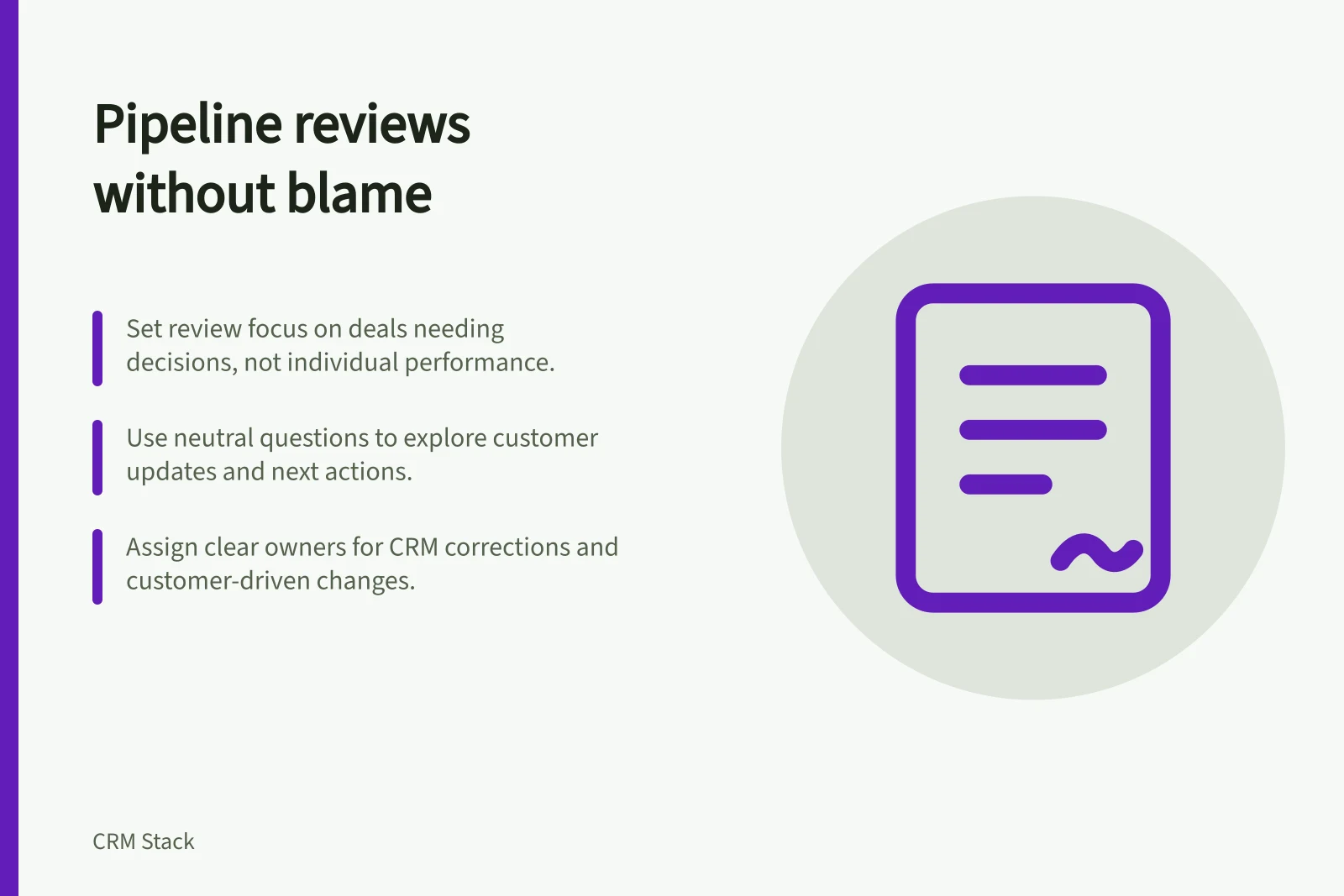
Run a pipeline review that settles deal questions, assigns record corrections and keeps individual coaching private.
Run the pipeline review around the deals and decisions that need attention. Settle record questions with their owners, discuss shared rules as a group, and handle individual coaching privately. The meeting should leave customer work clearer and corrections assigned.
Prepare a decision list
Set the population before the meeting, such as open opportunities due for a decision in the review period. Ask owners to check the customer event supporting each deal's current position, the expected date where one is used and the next action. An unknown answer is a question to resolve, not evidence of poor intent.
| Item | Group question | Result to record |
|---|---|---|
| Deal decision | What happened with the customer, and what happens next? | Decision, action owner and review point |
| Shared rule | Are several people interpreting a stage or field differently? | Rule owner and clarification needed |
| Individual difficulty | What support would help this person apply the rule? | Private follow-up |
A pipeline view can identify records for discussion. A displayed amount, date or stage still needs supporting context when it affects a decision.
Deal Decision vs. Shared Rule vs. Individual Difficulty
- Deal Decision
- What happened with the customer, and what happens next?
- Shared Rule
- Are several people interpreting a stage or field differently?
- Individual Difficulty
- What support would help this person apply the rule?
Ask neutral questions
Begin with what the customer has confirmed since the last review. Ask what remains open and what the team can decide now. If the stage does not fit the explanation, compare the record with the agreed stage rule. If a close date is only a hope, mark the uncertainty and assign a point to seek better information.
Avoid reading out incomplete fields under each person's name. That mixes data repair with performance judgement and can make an honest unknown less comfortable to report. Keep the group discussion to what is needed for the customer decision. Address repeated individual difficulty in a private conversation.
Close each correction
Before moving on, distinguish the change owed to the customer from the correction owed to the CRM. Name an owner for each and check both at the next review. Do not change stages or dates merely to improve the meeting's totals.
Look across deals for a common cause. Repeated uncertainty about a required field may mean it is requested too early; missing promises at handover may point to an unclear conversation rule. Send a shared process problem to its owner so the team applies one correction consistently. Keep sensitive account details and disputed performance questions with the people who need to resolve them.
Key Metrics for Pipeline Quality Review
- Open Opportunities Due for Decision
- To be determined by team
- Uncertain Close Dates Identified
- To be assessed during review
- Repeated Field Issues Detected
- To be escalated for process fix