Adoption
Part of CRM adoption and operating routines
Measuring adoption through useful records rather than logins
Define eligible customer work, check whether records support a handover and interpret CRM activity without mistaking logins for adoption.
Measure CRM adoption by whether records from expected customer work let someone act. Define the eligible work events, what a usable handover contains and how records will be reviewed. A login proves access, not whether a colleague can continue a deal or honour a promise.
Logins vs. Useful Records: Adoption Measurement Trade-offs
- Pros of Measuring LoginsSimple to track; shows system access
- Cons of Measuring LoginsDoes not confirm whether someone can act on a deal or honour a promise
- Pros of Measuring Useful RecordsConfirms operational readiness and handover capability
- Cons of Measuring Useful RecordsRequires manual inspection and context review
Define the population and standard
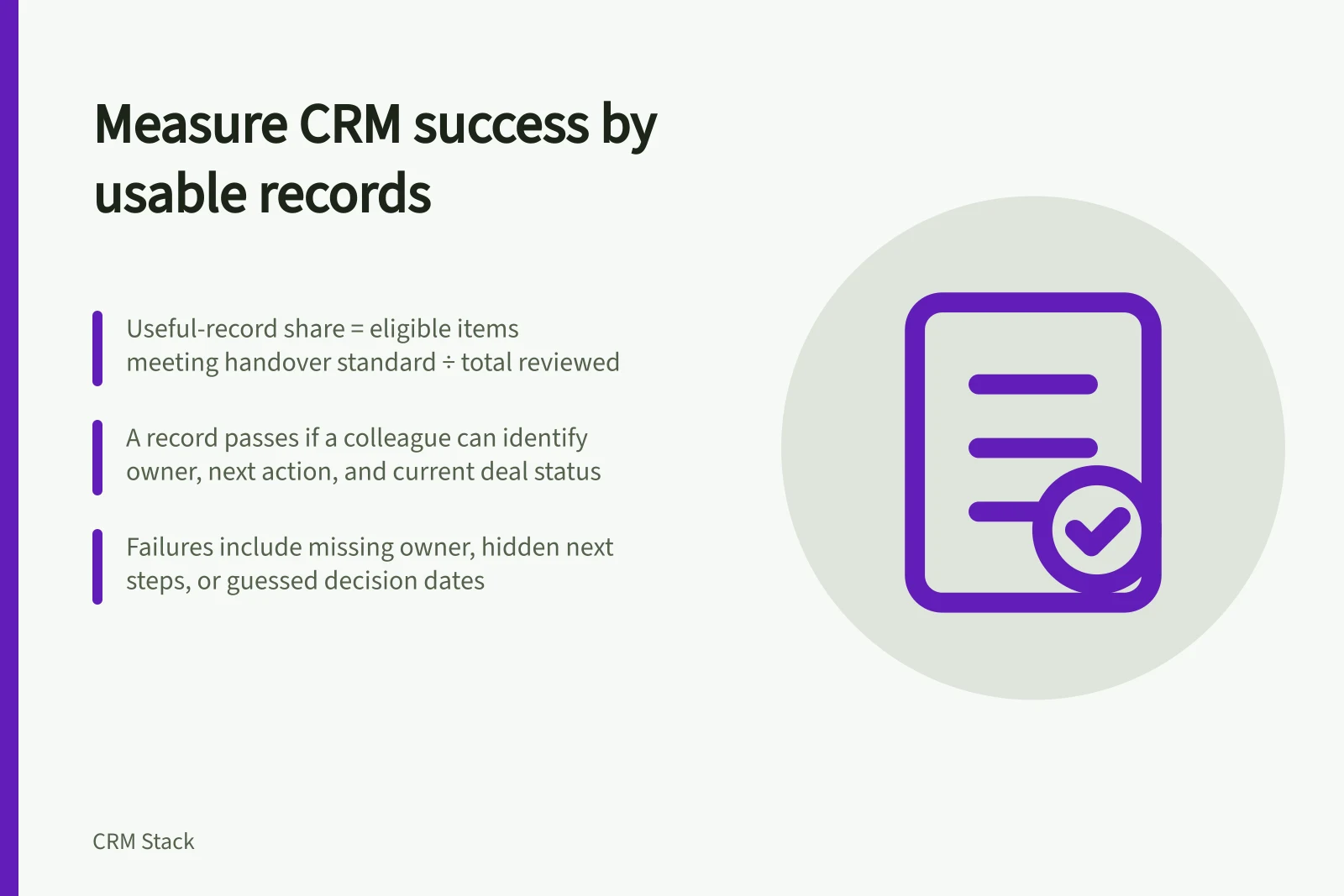
Pick one kind of work, such as open opportunities due for review after a customer interaction. Include every eligible item under a stated rule, even items with missing updates. For each, ask whether a colleague can identify the intended customer, current position, responsible owner and next action or review point. An honest unknown can meet the standard when the unresolved question and its owner are clear.
A closed opportunity needs an outcome, not a future task; a new enquiry may need a response owner before a deal stage. Use separate standards for unlike work. Tie this measure to handovers produced by the operating routine, not to an audit of every CRM field.
Useful-record share = eligible work items whose records meet the agreed handover standard ÷ eligible work items reviewed.
Beside the result, state the period, team, event or record type, inclusion rule and sample method. If a source event produced no CRM record, count that item as failing the standard rather than excluding it. The measure is a proposed local check, not a published benchmark or target.
Useful-Record Share: Key Adoption Metric
- DefinitionEligible work items with records meeting handover standard ÷ total eligible work items reviewed
- Measurement FocusUsable handovers, not login counts
- Inclusion RuleAll eligible items, including those with missing updates
- Audit ScopeHandovers from operating routine, not full field audit
Inspect what a colleague can use
A filled field may hold an old owner, guessed date or task linked to the wrong customer. For each sampled item, inspect the record and enough history to understand the open work. Ask a colleague with normal access to find the next step. Record why an item fails so its owner can choose a correction.
Finding / Question to resolve
- No accountable owner
- Where should the work have been assigned?
- ---
- ---
- Next action hidden in a note
- How should open work reach its owner?
- ---
- ---
- Decision date entered as a guess
- How should uncertainty be shown?
- ---
- ---
- Correct update on the wrong deal
- How was the record selected?
These are investigation prompts, not automatic diagnoses. A sample does not establish the condition of every CRM record.
Assessing Record Usability for Handover
- No accountable ownerWhere should the work have been assigned?
- Next action hidden in a noteHow should open work reach its owner?
- Decision date entered as a guessHow should uncertainty be shown?
- Correct update on the wrong dealHow was the record selected?
Interpret the result
Activity counts can flag cases worth investigating, but their meaning depends on role, workload, system settings and automated updates. Do not compare people by raw edit counts. Review failed items and unresolved exceptions alongside the useful-record share.
Keep the inclusion rule stable across periods, or show exactly how it changed. A rising share can mislead if unanswered customer work has left the population. Check whether corrected records now let the next person act.
For organisations subject to the Australian Privacy Principles, APP 1 requires an APP entity to take reasonable steps in the circumstances to implement practices, procedures and systems that ensure compliance with the APPs and to have a clearly expressed and up to date APP privacy policy about how it manages personal information. It does not prescribe this adoption measure or make every CRM field mandatory.